Can you still trust the voice and the face
on the other end?
Scammers already sound like your family, your doctor, your boss. Tomorrow, they'll look just like them too.
This Already Happened
‘Transfer $25 Million Now.’
In January 2024, a finance worker at Arup received a suspicious email. Then came the video call. On screen were the company's CFO and senior colleagues. Their faces looked right. Their voices sounded right. He made 15 transfers totaling $25 million.
Every person on that video call was an AI-generated deepfake.
Read the full story on CNNThe Threat Has Fundamentally Changed
Possible Today
Voice cloning from a 3-second sample
Your LinkedIn video, podcast, or voicemail is enough.
Real-time voice conversion on live calls
Sound like anyone while speaking naturally.
AI-generated video avatars
Interactive avatars that respond in real-time.
Coming in Months, Not Years
Real-time deepfake video calls
In standard conferencing tools like Zoom.
AI agents conducting fraud
Entire fraudulent conversations, automated.
Multi-person fake meetings
Generated "colleagues" in group calls.
The Arup incident required significant resources. Soon, it will require a laptop and an internet connection.
Why “Common Sense” Verification Is Now Failing
The Old Advice
- Call them back on their number.
- Ask a secret question.
- Agree on a static code word.
The New Reality
The attack IS a real-time video call.
What second channel do you use?
"Secret" questions are public.
Your mother's maiden name and first pet are on social media.
Static code words fail human memory.
Especially under the exact pressure conditions when you need them most.
Fraudsters create urgency precisely because verification takes time.
By the time you've confirmed something's wrong, the money is gone.
A New Layer of Verification for All Your Communications
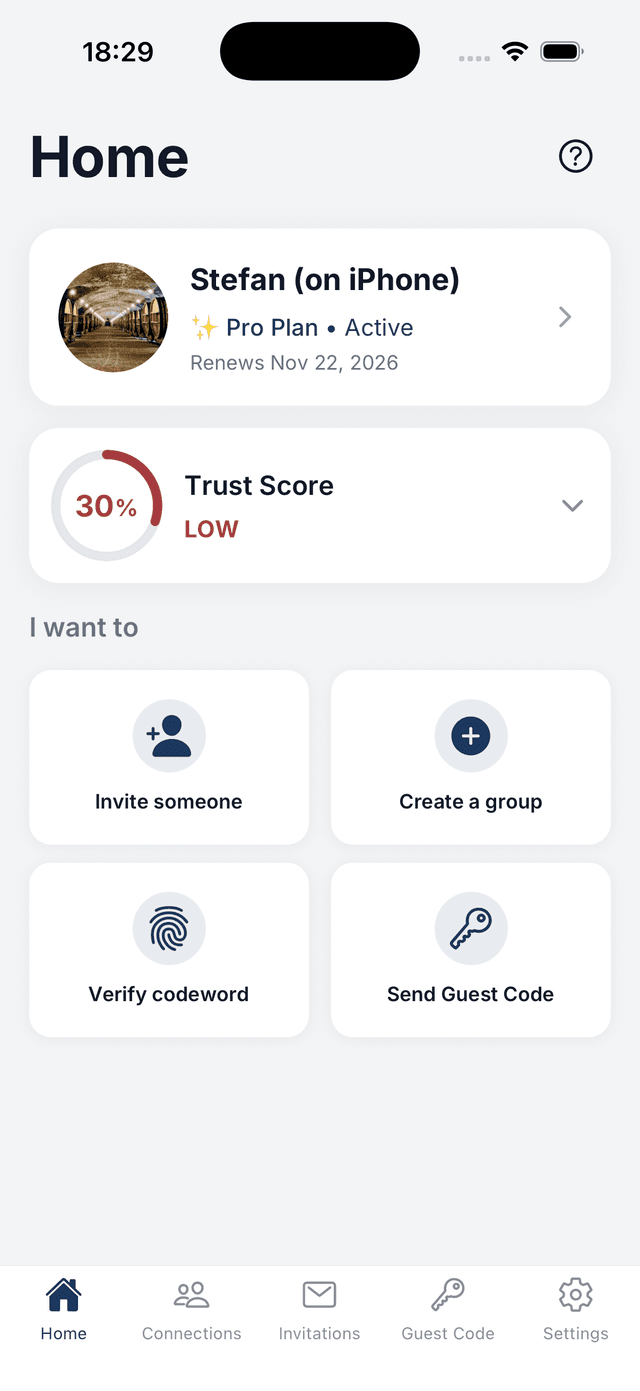
The principle is simple: Every person in your trusted network has a three-word code that you can see in an app. The code changes automatically.
Trusted Codes Verification Layer
How it Works: “What's your code?”
- ⏱It takes 3 seconds.
- 📱It works on any channel.
- 🧠It requires zero memory.
- 📡It works completely offline.
Example Code
Mountain.Coffee.Bicycle.
Words create mental images. They stick. They're pronounceable and memorable, even when you're stressed.
Effortless Verification in Action
The CEO Fraud
An "urgent" payment request is stopped by a 2-second code check.
Impersonator hangs up.
The Deepfake Conference Call
A "client" joins to change contract. The code request reveals the deepfake.
Fraud prevented.
The Grandparent Scam
An AI-cloned voice of a "grandson" in trouble is defeated.
"What's your code, sweetheart?"
A simple question protects against financial loss, data breaches, and family distress.
Security by Design
Why Three Words Are More Secure Than Numbers
847291
Your brain processes digits abstractly.
Hard to recall under pressure.
Mountain. Coffee. Bicycle.
Words create mental images.
Pronounceable and memorable.
8,589,934,592
Possible combinations
Three words from 2,048 curated words
99 days
To brute-force at 1,000 guesses/sec
But the code changes in 24 hours
24 hours
Code rotation
Overheard codes become useless
Zero-Knowledge Architecture
Your secrets are never exposed.
End-to-end encryption ensures only you and your contact can generate codes.
A server breach is irrelevant to your security.
Even if our database is stolen, your secrets remain encrypted with keys we don't have.
Codes are generated 100% offline.
They are never transmitted, preventing interception.
The Question That Matters
When their face looks right and their voice sounds perfect...
How will you know it's them?
Free Forever
For families
Enterprise
Contact us for business
Fraudsters optimize for easy targets. The goal isn't to be un-hackable; it's to be a harder target than the alternative. Protection shouldn't be a luxury.